Samvaad
Problem Statement
We have all been in situations where even after reading and uploading docs to LLMs and querying, some topics just don't click. In that position, we often switch to asking friends, colleagues, or peers, who can explain things via voice-dialogues, and in our own native language.
However, not everyone has access to such a support system at all times, and traditional search doesn't fill the gap.
Solution
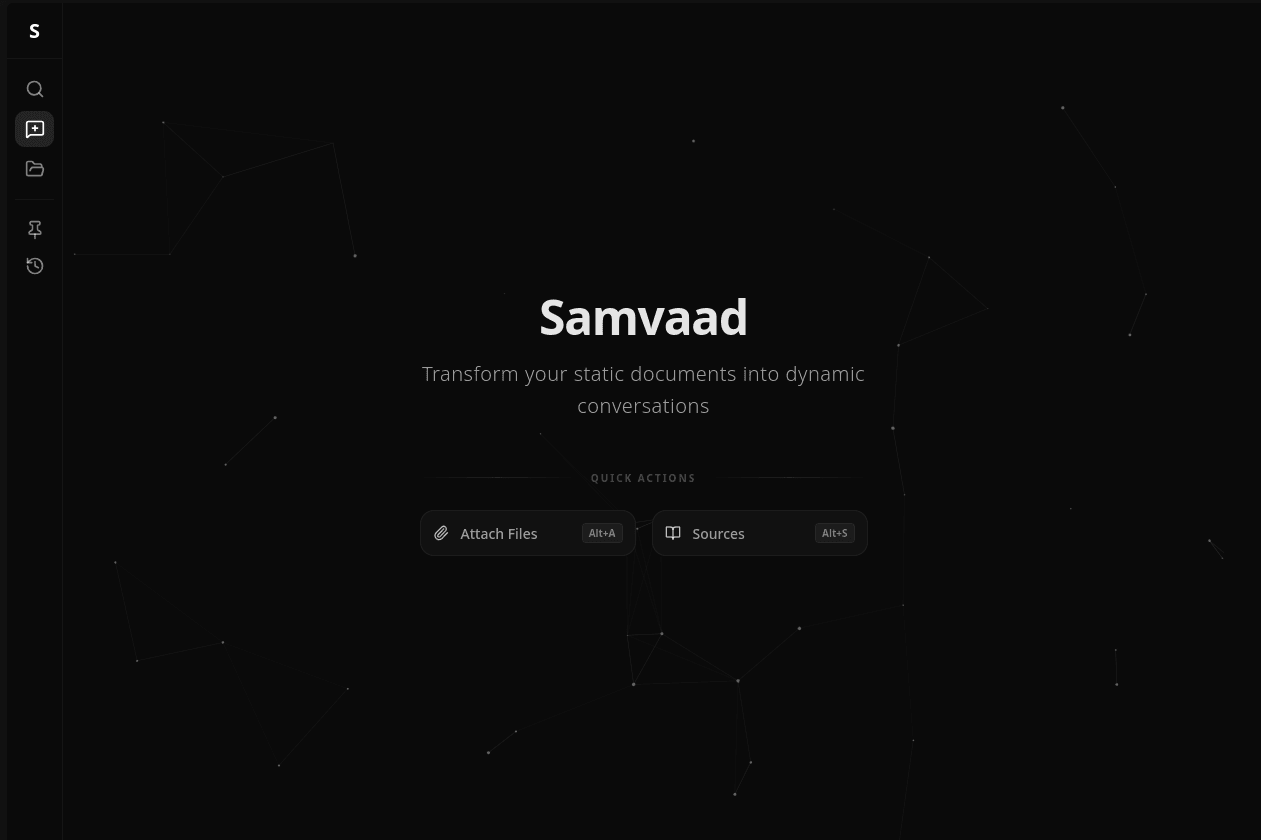
To address this problem, I built Samvaad, a full-stack Retrieval-Augmented Generation (RAG) platform that transforms static documents into interactive, dialogue-driven learning experiences. By combining state-of-the-art vector retrieval with ultra-low-latency WebRTC voice conversations, Samvaad allows you to talk to your knowledge, literally.
Samvaad is now live at samvaad.live.
What's Unique About This?
Samvaad stands out with its real-time voice mode, enabling natural conversations with your documents. It features intelligent deduplication, verified citations to eliminate hallucinations, and a modern full-stack architecture optimized for performance.
Architecture
Backend (Python)
- Framework: FastAPI (Asynchronous, High Performance)
- Database: PostgreSQL (Supabase) with
pgvector(Vector similarity search) - Voice Framework: Pipecat & Daily
- AI/LLM: Groq, Voyage AI (Embeddings), Deepgram (STT/TTS)
Frontend (TypeScript)
- Framework: Next.js 16 (App Router)
- Styling: Tailwind CSS with a custom "Void" Dark Theme
- UI Components: Shadcn/ui & Framer Motion
- Auth: Supabase
Key Components
- Document Ingestion: Supports PDF, Docx, Images (OCR) via LlamaParse.
- Intelligent Deduplication: Content-addressable storage (SHA-256) ensures zero-redundancy.
- Real-Time Voice Mode: Ultra-low latency using WebRTC (Daily) and Pipecat.
- Verified Citations: Every claim backed by atomic citations linked to source documents.
Problems Faced
- I focused really hard on making top-notch UX. My stubborness here probably causes a lot of bugs, which I spend time cleaning up.
- Pipecat does a lot of the heavy lifting, but integrating voice and text mode is challenging.
- Manaing context and conversations was also a challenge.
Learnings
Since evolving Samvaad into a full-stack platform, I learned:
- How to build and deploy a high-performance FastAPI backend with async capabilities.
- Integrating voice frameworks like Pipecat and Daily for real-time interactions.
- Implementing vector databases and similarity search with pgvector.
- Developing modern Next.js applications with authentication via Supabase.
- Optimizing for low-latency voice conversations and verified citations.
Future Vision
Immediate Plans
- Enhance the voice mode with support for more languages and dialects.
- Improve the RAG pipeline for even better retrieval accuracy.
- Add collaborative features for shared document conversations.
Long-term Plans
- Expand to mobile apps for Android and iOS.
- Add cross-chat memories so agents can help you learn how you want.